


For businesses shipping, storing, and handling products every day, the strength of a corrugated box matters. A box that cannot withstand the demands of a warehouse or distribution environment can buckle, crush, or compromise the products it is supposed to protect.
One of the most common ways to evaluate corrugated packaging is through its Edge Crush Test, or ECT, rating. Understanding plain box ECT compression strength explained in practical terms can help businesses make more informed packaging decisions based on stacking, handling, storage, and transportation requirements.
What Is an ECT Rating?
The Edge Crush Test measures the resistance of corrugated board to crushing when force is applied to its edge. The resulting ECT rating provides an indication of how well the corrugated material can resist compression.
This is particularly important because boxes are frequently stacked during storage and transportation. Boxes toward the bottom of a stack must support the weight placed above them without losing their shape or structural integrity.
ECT ratings are generally expressed in pounds per linear inch. A higher rating indicates greater edgewise compression strength, but that does not automatically mean every application needs the highest rating available.
Selecting an appropriate box requires considering the entire packaging environment.
Why Compression Strength Matters for Plain Boxes
Plain corrugated boxes are used throughout industrial and retail supply chains because they provide straightforward, versatile packaging. Businesses may use them for finished goods, components, supplies, inventory transfers, and many other products.
Compression strength becomes especially important when boxes are palletized. Each lower box may have to support several layers of additional product, and that load can remain in place throughout storage and transportation.
Insufficient strength can result in bulging panels, crushed corners, unstable pallet loads, or collapsed boxes. Appropriate corrugated construction helps packaging maintain its form and gives businesses greater confidence when products move through warehouses and distribution networks.
ECT Ratings and Stacking Performance
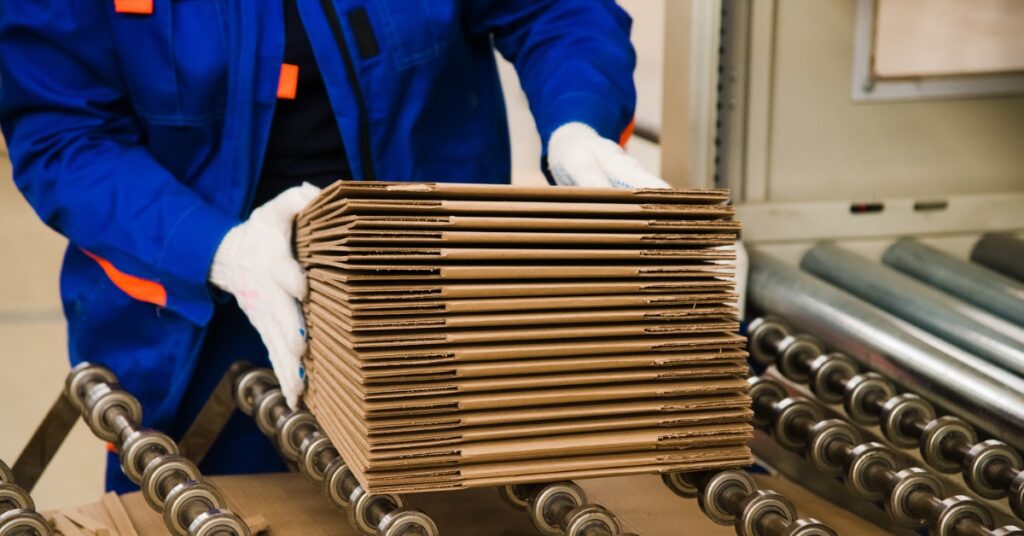
An ECT rating is closely connected to stacking performance because the vertical edges of a corrugated box contribute significantly to its ability to carry a load.
When boxes are stacked evenly, their edges help transfer weight downward. Corrugated material with sufficient edge compression strength can better resist the forces created by the boxes and products above it.
However, ECT should not be viewed as a guarantee of a specific stacking capacity. Actual performance can change based on box dimensions, board construction, contents, pallet patterns, environmental conditions, and how long the load remains stacked.
Businesses should therefore evaluate ECT as one part of the overall packaging specification rather than relying on the rating alone.
Understanding Common ECT Differences
Corrugated boxes are available in different ECT ratings to accommodate different packaging demands. Choosing between them should begin with the product, shipping method, and expected handling conditions.
A lighter product moving through a relatively controlled distribution process may not require the same board strength as dense industrial components stacked several layers high. Likewise, a box that spends significant time in warehouse storage may experience different compression demands than packaging used primarily for short-distance transportation.
Using more material than an application requires can increase packaging costs unnecessarily. Using too little strength, however, may contribute to product damage and inefficient handling.
The goal is to match the corrugated specification to the actual application.
Box Design Also Affects Compression Strength
ECT provides useful information about corrugated board, but the completed box is a packaging system. Dimensions, flute configuration, wall construction, manufacturing quality, and closure methods can all influence performance.
The relationship between length, width, and height is particularly important. Two boxes made from material with the same ECT rating can behave differently when their dimensions and load configurations differ.
Box condition matters as well. Creased, crushed, torn, or otherwise damaged corrugated material may not provide the same structural performance as material in good condition.
That is why packaging decisions should account for both material specifications and the way the box will actually be used.
The Effect of Moisture and Warehouse Conditions
Corrugated packaging is made primarily from paper-based materials, which means environmental conditions can influence its performance. Exposure to high humidity or moisture can reduce the rigidity and compression strength of corrugated board.
This can become important for businesses storing packaged products for extended periods or operating in environments where humidity fluctuates. A box that performs well under controlled conditions may behave differently after exposure to moisture.
Warehouse teams should consider storage conditions when establishing packaging requirements. Keeping corrugated materials dry and properly stored can help preserve their structural properties before use.
Packaging specifications should also account for the conditions boxes are expected to encounter throughout the supply chain.
Compression Strength and Used Corrugated Packaging
Used corrugated packaging can offer businesses a practical option when boxes remain in suitable condition for their intended application. Evaluating condition is particularly important when boxes will be stacked or subjected to substantial loads.
Previous use, moisture exposure, crushed edges, tears, and other damage can affect structural performance. Businesses using previously handled boxes should therefore consider both the original specification and the box’s present condition.
This is also relevant for companies generating significant quantities of reusable packaging. Businesses with excess inventory may be able to sell used Gaylord boxes rather than treating serviceable corrugated packaging as waste.
Keeping usable packaging in circulation can help companies manage surplus materials while providing another source of boxes for appropriate industrial applications.
Matching ECT Strength to Operational Needs
The practical value of understanding ECT compression strength for plain corrugated boxes comes down to matching packaging with real operating conditions. ECT ratings provide businesses with an important way to compare the edgewise compression resistance of corrugated materials, but they should be considered alongside box design, product weight, stacking patterns, storage conditions, and handling practices.
For companies purchasing boxes in bulk, getting the specification right can support more efficient packaging operations and reduce the risks associated with underperforming boxes. It can also help avoid unnecessary material costs caused by consistently specifying packaging that exceeds actual requirements.
United Container Co. works with industrial and retail businesses that need corrugated packaging in volume, including used packaging and custom new boxes. Contact United Container Co. to discuss your packaging requirements and request a quote for boxes that fit your shipping, storage, and handling needs.
Posted by